

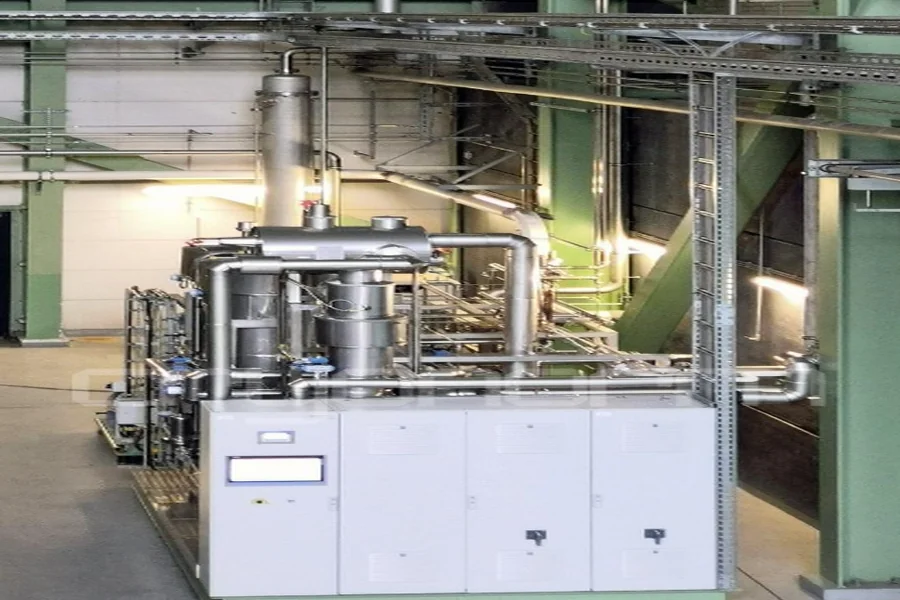
How does CO2 liquefaction work?
In CO2 liquefaction, an available CO2 stream is converted to the liquid phase through cooling and process control. For reliable production of LCO2, temperature and pressure must be precisely controlled throughout the process. The quality and composition of the incoming gas stream also play an important role. The plant is therefore tailored to the specific situation and the desired production volume. The result is liquid CO2, which can then be stored and, depending on the required quality and application, used in various industrial processes.
CO2 from Biological Processes as a Source
An interesting source for CO2 liquefaction is CO2 generated during biological processes, such as fermentation. In such processes, a significant amount of carbon dioxide can become available. By not simply treating this CO2 as a waste stream, but rather recovering and liquefying it, it becomes possible to reuse locally produced CO2. This can contribute to a more efficient use of available raw materials and, at the same time, reduce dependence on traditionally produced liquid CO2. For smaller and medium-sized production sites in particular, a system that integrates with the available gas stream is therefore of interest.
Modular CO2 Liquefaction for Various Capacities
Not every production site requires a large-scale system. That is why a modular approach to CO2 liquefaction can be attractive. A compact system can be tailored to the actual amount of available CO2 and the specific on-site conditions. As a result, the system does not need to be larger or more complex than is necessary for the process. Modularity also makes it possible to design various components as a single integrated solution. More information about the technical possibilities can be found under CO2 liquefaction.
When designing a CO2 liquefaction plant, various factors determine the final configuration. The source of the gas, the desired production capacity, and the specifications of the end product all influence the design. Available space, operating hours, and integration with existing facilities can also play a role. A suitable solution therefore requires a technical approach that takes the entire process into account.
Key considerations include:
- the composition and quality of the incoming CO2 stream;
- desired capacity and operating hours;
- required quality of the produced LCO2;
- available space for installation and storage;
- integration with existing processes and facilities.
Frequently Asked Questions About CO2 Liquefaction
What is the difference between CO2 and LCO2? CO2 is the gaseous form of carbon dioxide. LCO2 (liquid CO2) is the same substance, but converted to a liquid form through cooling and pressure control,this takes up significantly less space and is easier to store and transport.
What is liquid CO2 used for? Depending on its quality, LCO2 can be used in various industrial processes and markets, such as those where CO2 is used as a raw material or process aid.
Is CO2 liquefaction also suitable for smaller gas streams? Yes. A modular, compact system can be tailored to the actual amount of available CO2, making liquefaction accessible even for small and medium-sized production sites.
A Suitable CO2 Liquefaction Plant
No two CO2 liquefaction applications are exactly the same. Differences in capacity, gas source, operations, and desired product quality require a solution tailored to the specific situation. A thorough technical analysis therefore forms the basis for determining the correct configuration. This analysis considers not only the liquefaction process itself, but also the integration with surrounding systems and the desired method of storage and distribution. The result is a plant that fits seamlessly into the entire production process.
By making CO2 available in liquid form, an existing gas stream can be transformed from a byproduct into a valuable raw material. This technology thus offers interesting opportunities for producers who want to recover, store, or make CO2 available locally for further use. In particular, the combination of a compact design, scalability, and customization to the specific gas stream makes CO2 liquefaction suitable for a wide range of industrial projects.
